Introduction to Dysphagia
*Please note: This slide show is not intended to be a substitute for professional medical advice, diagnosis, or treatment. Always consult your doctor about any questions you may have regarding a medical condition.
What is dysphagia?
Dysphagia is the medical term for difficulty in swallowing.1
What is dysphagia?
It can include discomfort, pain, food or drinks getting stuck, coughing, choking, heartburn, or feeling like food wants to come back up or regurgitate.2
What is dysphagia?
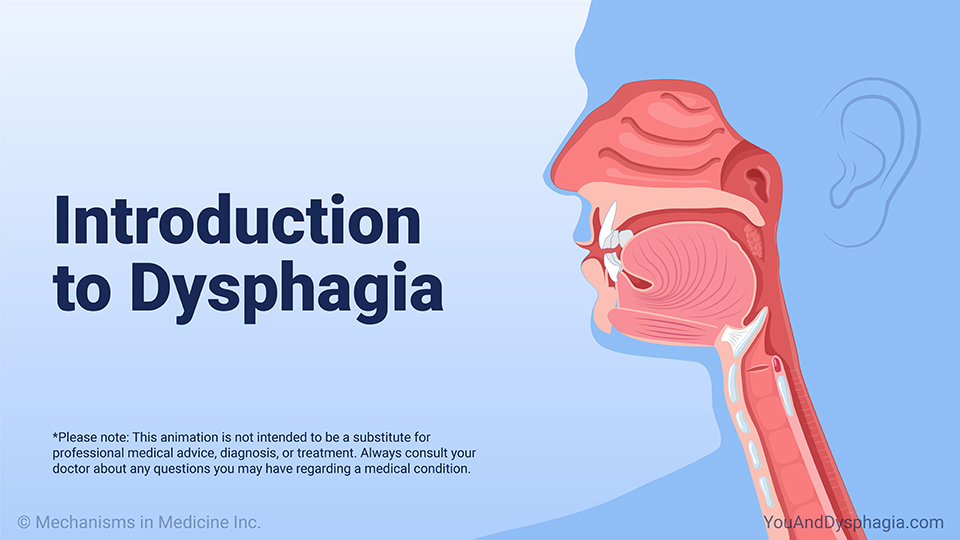
Dysphagia can be classified by where in the swallowing tract it occurs. Swallowing difficulties in the mouth and throat are called oropharyngeal dysphagia. Dysphagia coming from the esophagus is called esophageal dysphagia.
Your esophagus is the tubelike structure that carries food and liquids to your stomach.2 It runs from the bottom of the throat to the top of the stomach.
The importance of swallowing
Swallowing lets you eat, drink, take medicine, and enjoy life.3
The importance of swallowing
If swallowing is difficult, you may feel anxious or, as you will learn, develop health problems.3
How we swallow
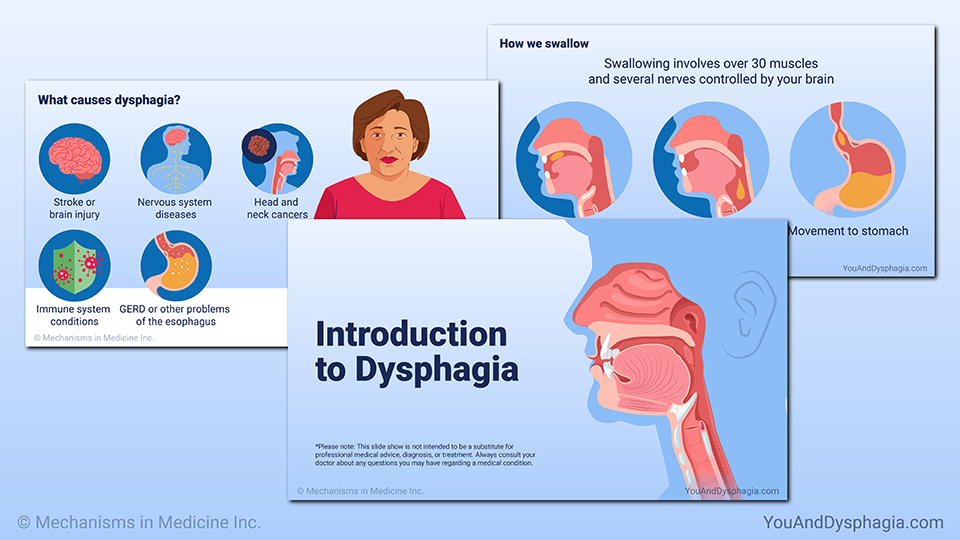
Swallowing involves over 30 muscles and several nerves controlled by your brain.4
Food moves from your mouth, where you chew, through your throat, where coordinated muscles push it through your esophagus, the passage which carries it to your stomach.
How we swallow
This complex process requires precise timing by your brain, nerves, and muscles. Any disruption can cause swallowing problems.4,5
Who gets dysphagia?
Dysphagia affects millions of adults worldwide.5 It’s especially common in older people and those who have certain medical conditions or treatments.5 Dysphagia can also occur in children.
What causes dysphagia?
Dysphagia can occur from:2,5
- Stroke or brain injury
- Nervous system diseases
- Head and neck cancers
- Immune system conditions (such as scleroderma and myasthenia gravis)
- GERD or other problems of the esophagus
What causes dysphagia?
It can also be caused by:
- Medications causing dry mouth
- Radiation therapy can impact muscle movement over time
Dysphagia signs and symptoms
If you often cough, choke, or feel food stuck in your throat, talk with your doctor.1 Other symptoms of dysphagia can include pain when swallowing, drooling, trouble when you start to swallow, and a wet or gurgling voice after eating or drinking.2,5
Dysphagia can cause health problems
Untreated dysphagia can lead to serious problems. These include a lung infection from food or liquid getting into the lungs, malnutrition from not eating enough, dehydration from avoiding liquids, weight loss, and social isolation or depression from avoiding meals with others.3,5
Early treatment helps prevent these complications and helps you live as well as possible.
Diagnosing dysphagia
Collaborative team care is key in the diagnosis and in the care of patients with dysphagia. Usually, an otolaryngologist-head and neck surgeon or ENT specialist, a speech language pathologist, or gastroenterologist are involved in your diagnosis and care.5
Diagnosing dysphagia
A swallowing X-ray called videofluoroscopy involves drinking liquid that shows up on video.4 A test called FEES (short for fiberoptic endoscopic evaluation of swallowing) uses a small camera on a tube, called an endoscope, to watch the swallowing process.5
Another test, manometry, can help check muscle strength.4,5 None of these tests hurt, and your healthcare team will be able to explain what they learn about your dysphagia.5
Managing dysphagia
Dysphagia can be managed and treated. Management strategies can modify swallowing to better direct food to the esophagus.
Managing dysphagia
These temporary strategies compensate for the swallowing problem. Common strategies include posture changes such as a chin tuck or head rotation.
Managing dysphagia
Sitting up straight and taking small sips or bites can also help.4
Other strategies include thickening drinks to help keep them from going down the wrong way. Soft foods and purees are easy for most people to swallow.5
Diet changes may be temporary, until you learn safer ways to swallow or the cause of dysphagia is treated.4
Treatment for dysphagia
Treating the condition causing dysphagia with exercise can help. Unlike management strategies, exercise therapies aim to permanently improve the swallow movements. For example, exercise rehabilitation can help if a stroke or head and neck cancer is the cause of your dysphagia.5,7
If a physical blockage narrows your throat preventing food from passing through, you might need surgery or another procedure.7 For example, if the blockage causing your dysphagia is a cancer, the cancer treatment would be directed by your cancer specialists.
Changing medications or
treating conditions, like acid reflux or GERD, can make swallowing safer and easier.
2,7
Therapy for dysphagia
A therapist, such as a speech language pathologist with expertise in swallowing disorders can teach you exercises called swallowing retraining therapy for the muscles, nerves, and other structures involved. Exercises might include chin stretches, tongue presses, or practicing swallowing in a certain way.5,7
Simple, well-targeted movements can lead to safer, more comfortable swallowing.4
Therapy for dysphagia
For patients with head and neck cancer for whom surgery or radiation may cause swallowing problems, starting exercises before cancer treatment may help prevent problems or make them less severe. This is called prehabilitation treatment or 'prehab'.5,6
Living with swallowing problems
Dysphagia can happen at any age and for many reasons. Good collaborative care makes a great difference.1,3
Living with swallowing problems
It's important to remember that swallowing is complex, and that any change in the structure of the mouth and throat or the muscles and nerves involved in swallowing can affect the entire process.
Education equals hope
Asking questions, making informed choices, and working closely with your provider team is the key to coping with swallowing problems and staying as healthy as possible.1,3
References
- American Speech-Language-Hearing Association. (n.d.). Adult Dysphagia. (Practice Portal).
https://www.asha.org/Practice-Portal/Clinical-Topics/Adult-Dysphagia
- UHN Swallowing Lab – Dr. Rosemary Martino. (2024). What is Dysphagia?
https://swallowinglab.com/patients-family
- Ekberg O, Hamdy S, Woisard V, Wuttge-Hannig A, Ortega P. Social and psychological burden of dysphagia: its impact on diagnosis and treatment. Dysphagia. 2002 Spring;17(2):139-146.
- Shaw SM, Martino R. The normal swallow: muscular and neurophysiological control. Otolaryngol Clin North Am. 2013 Dec;46(6):937-956.
- National Foundation of Swallowing Disorders (NFOSD). (2025). Patients and Caregivers resources: Swallowing Disorder Basics.
https://swallowingdisorderfoundation.com/about/swallowing-disorder-basics
- Starmer H, Gourin C, Lua LL, Burkhead L. Pretreatment swallowing assessment in head and neck cancer patients. Laryngoscope. 2011 Jun;121(6):1208-1211.
- Martino R, McCulloch T. Therapeutic intervention in oropharyngeal dysphagia. Nat Rev Gastroenterol Hepatol. 2016 Nov;13(11):665-679.
Dysphagia, or difficulty swallowing, can affect people of all ages and have a significant impact on health, nutrition, and quality of life. This slide show provides a clear, easy-to-understand overview of dysphagia, explaining what it is, why swallowing is such a complex process, and how swallowing problems can develop. Click through to learn about the
common signs and causes of dysphagia, the importance of
early recognition, the potential
health consequences of untreated swallowing difficulties, and how dysphagia is
diagnosed. You will also gain insight into
management strategies,
treatment options, and
rehabilitation approaches to improve swallowing safety and function.
-
Share with family and friends:
Click here to take our SURVEY
Your feedback is important to us! We will use your feedback to develop future areas of content about dysphagia which will help other patients, caregivers, and families.